
High Voltage Impulse Testing
An Introduction to High Voltage Impulse Testing
At APC Technology Group, we work with a wide range of high-voltage testing applications. These include voltage-withstand (or Hipot) testing, partial-discharge measurement, and both type and routine testing of transformers and motors – each a fascinating area in its own right. However, in this article, we will focus on high-voltage impulse testing. When we talk about "high voltage," it's important to understand the scale we're dealing with.
For an RF design engineer, high voltage probably means around 30V DC, which is needed for the latest in surface mount GaN amplifiers. For power electronics engineers, like those in the electric vehicle (EV) and solar photovoltaic (PV) markets, they likely need up to maybe 1500V and here you could need multiple phases of AC power. For us at APC, when we talk about HV we need to add a few extra zeroes.
Our partner for these solutions is Haefely in Switzerland and the largest ‘standard’ voltage impulse generators we work with getting to provide up to 10 MV, that’s 10 000 000 V, albeit for a very short period. For perspective, that puts us on the same scale as a bolt of lightning, and that is pretty much the point!
How is an impulse generated?
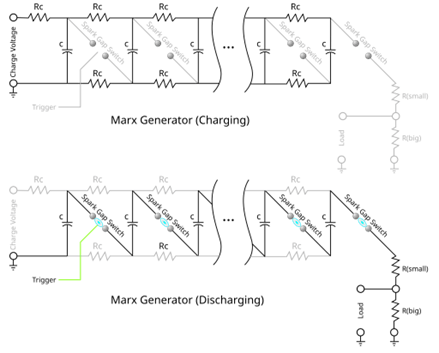
The simplest and most scalable method of generating a voltage impulse is by using a circuit called a Marx generator, named for Erwin Otto Marx in 1924.
The principal involves using a relatively low voltage supply to charge a bank of capacitors in a parallel circuit. Once these capacitors are fully charged, they must be rapidly switched into a series configuration, causing them to discharge to ground through your equipment under test.
What is an impulse test?
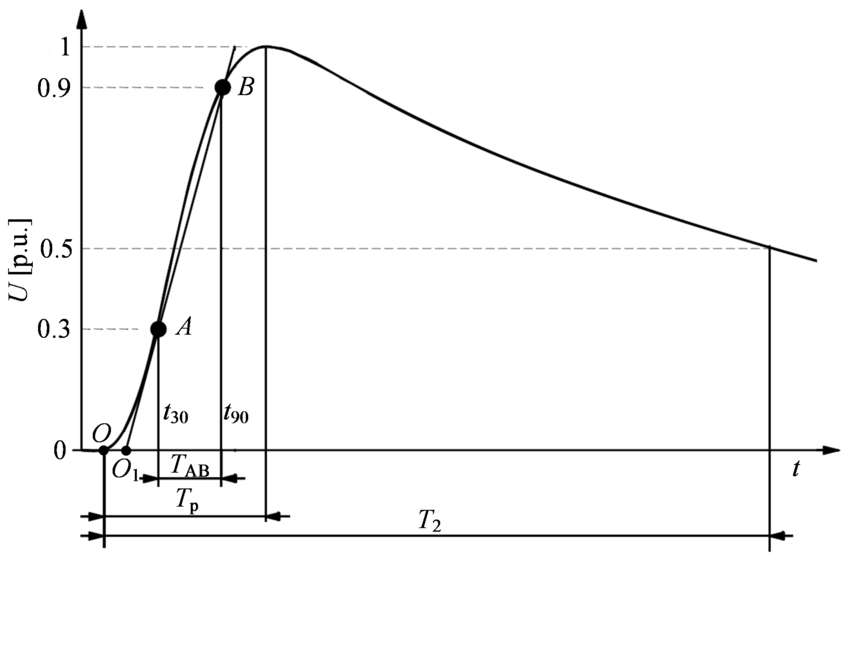
An impulse is, in essence, a very condensed signal pulse with usually a high peak and a very short length. These signals are applied to a piece of equipment under test most commonly to check how a product will cope when lightning strikes in the field. These tests test the reliability of the dielectric in the equipment-under-test while limiting the thermal load, relative to a longer test.
Manufacturers of electrical distribution hardware, like power transformers, and satellite and aerospace manufacturers, will be required to test to this extent, which is cast into the regulation of those industries.
For example, IEC 60076-3 dictates the test levels for power transformer impulse testing.
The devil is in the details though. To tune the parameters like the peak voltage, the rise time, and the decay time, you need to carefully select your components and need very fine control over your switching. A variable width spark gap is used as a trigger most often, since this is the quickest possible way to change the circuit from the charging to the discharging mode.
Impulse Voltage Generator Models
Through our partnership with Haefely, APC is available in the UK to provide and support you with a range of voltage impulse systems and other high-voltage test solutions.
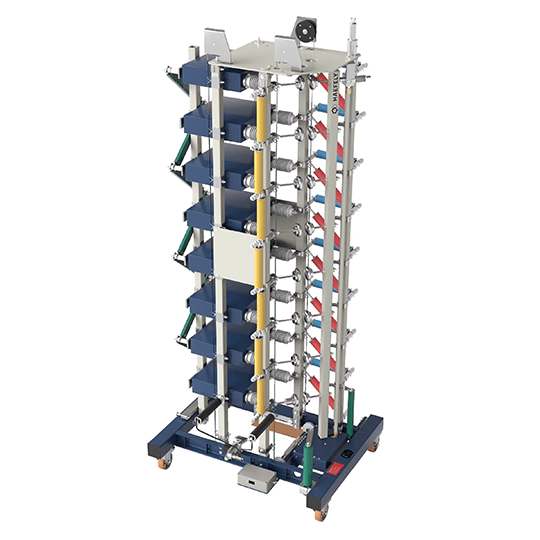
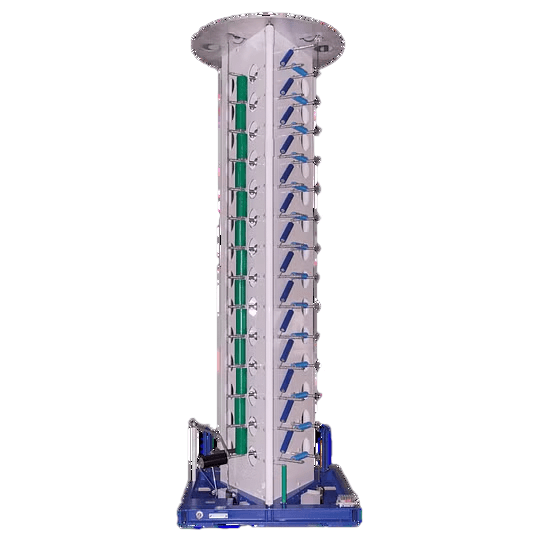
The SGSA, SGDA, and SGVA series of Marx Generator products from Haefely cover a wide range of applications and offering increasing voltage and power levels depending on your testing needs.
SGSA Impulse Voltage Test Systems
100 kV - 1'200 kV
SGSA is the smallest of the three impulse voltage generator models. Capable of delivering 10 kV to 1200 kV across a range of models. With 5 kJ as per stage energy SGSA is useful on LV and MV network components.
SGDA Impulse Voltage Test Systems
200 kV – 3’000 kV
SGDA is the second of the three impulse voltage generator models. Capable of delivering 10 kV to 3 200 kV across a range of models. With 5 kJ or 10 kJ as per stage energy SGDA is useful on LV and MV and HV network components.
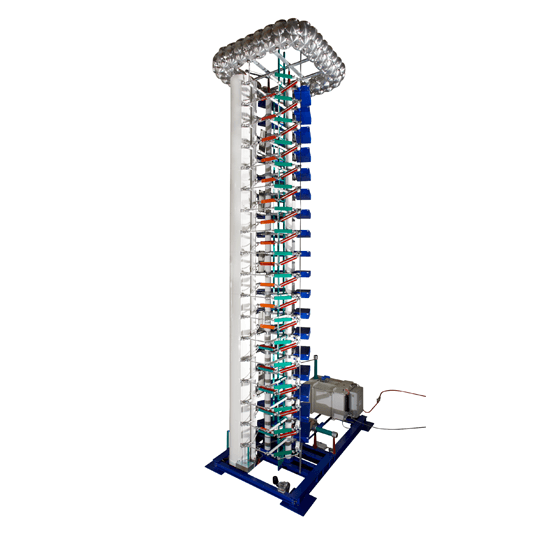
SGVA Impulse Voltage Test Systems
400 kV – 10’000 kV
SGVA is the largest of the three impulse voltage generator models. Capable of delivering 20 kV to 10'000 kV across a range of models. With 20 kJ or 30 kJ as per stage energy SGVA is useful on HV and UHV network components.
About the Author
Sam Humphriss, MSc
Business Development Manager, Test & Measurement Solutions at APC Technology Group
As a member of our Test and Measurement division at APC Technology Group, Sam Humphriss is an expert in high-voltage (HV) Test Solutions. With a background in Physics, Sam spent several years working with radio frequency (RF) components before becoming an applications specialist in the test team.
Contact us
Contact our team for technical advice and pricing support for your High Voltage Impulse testing requirements.