
Hipot Testing Explained: Tests, Standards & Equipment
Hipot testing proves that a product's insulation can withstand a voltage well above its normal operating level, a fundamental electrical-safety check before a product reaches the market. This guide explains hipot and the related safety tests, how to choose a tester and the equipment APC supplies to perform them.
What is hipot testing?
Hipot (high potential) also written (hi-pot), dielectric withstand and dielectric voltage withstand all name the same test. It applies a voltage above a product's normal operating level between its live parts and its accessible or earthed parts and measures the resulting leakage current. If the insulation breaks down or arcs over, the product fails.
The test proves that the insulation can withstand transient overvoltages safely. It also catches manufacturing faults that weaken insulation, such as pinholes, scrapes, inadequate spacing, crimps, trapped moisture and contamination. Hipot testing is used across finished-product safety, cable and wiring-harness testing and transformer and wound-component testing.
The four electrical safety tests
Hipot is one of four tests that together verify electrical safety. A combined safety analyser performs all of them in sequence.
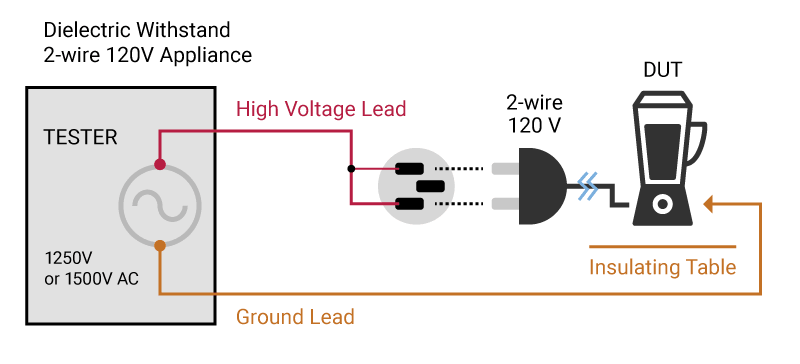
Dielectric withstand (hipot)
Applies a high voltage (AC or DC) above the operating level and detects insulation breakdown or flashover through the leakage current. A pass/fail withstand test.
Insulation resistance (IR)
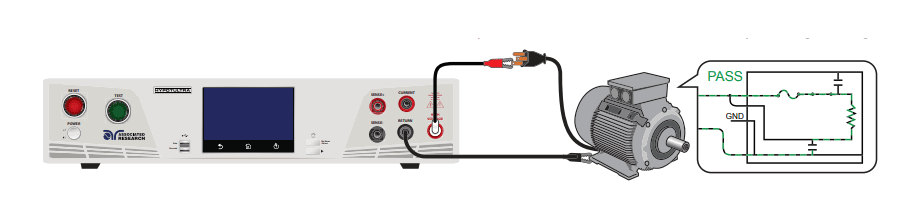
Applies a DC voltage (typically 50 - 1000 V) and measures the insulation resistance in megohms. It is non-destructive and standards often set a minimum such as 10 MΩ. Some procedures run IR, then hipot, then IR again to confirm the hipot did not degrade the insulation.
Leakage current
Measures the current that would flow through a person using a network that simulates body impedance, while the equipment runs. It checks touch and earth leakage stay within safe limits.
Ground bond/continuity
Verifies the protective-earth path. A ground continuity test passes about 1 A and checks the resistance is below 1 Ω, a ground bond test passes 25 A or 1.5 x the rated current and checks the resistance is typically below 100 mΩ.

ARC Test
ARC is a type of electrical discharge that occurs when the insulation capability is insufficient. If ARC occurs multiple times, the system will fail. ARC may occur within 10us; thus, the resolution and sensitivity of ARC judgement will influence the test result.
Hipot vs insulation resistance (megger test vs hipot)
A "megger" is an insulation-resistance tester: it applies a DC voltage and reads the insulation resistance in megohms or gigohms. It is a non-destructive measurement. Meggers test low to medium voltage with a typical voltage between 600V and 2000V.
A hipot applies a much higher stress voltage and looks for breakdown through the leakage current. It is a withstand test with a pass/fail result. Hipot testing applies significantly higher voltages, typically above 15,000V.
Both answer different questions. Insulation resistance asks "how good is the insulation?" whilst hipot asks "will the insulation survive a defined over-voltage?". Both are useful and many standards call for both.
AC vs DC hipot
Where a standard permits a DC test, the hipot test formula sets the DC voltage to the peak of the AC value:
DC test voltage = AC (RMS) × 1.414
Always check the relevant standard before substituting DC for AC.
AC Advantages: stresses both polarities; no voltage ramp needed; widely accepted by safety agencies; no need to discharge the DUT afterwards.
AC Disadvantages: measures total (capacitive plus resistive) leakage; needs a larger, costlier transformer.
DC Advantages: measures resistive leakage only, giving a true value; no reactive current,so fewer false failures; lower current, lower cost and lower operator risk; easier on capacitive products.
DC Disadvantages: needs a ramp-up and a discharge afterwards; stresses one polarity only; not accepted by every standard.
How to choose a hipot tester
- Voltage capability - as a rule of thumb, choose a tester that supplies at least 2 ×working voltage + 1000 V
- Output - AC, DC or both, depending on your standard
- Tests needed - hipot only, or hipot plus insulation resistance, leakage current, and ground bond in one combined safety analyser
- Automation - manual, semi-automatic or fully automatic test sequencing
- Production - for high volumes, multi-channel testers handle many devices at once, and features such as simultaneous hipot and ground bond, plus open/short check (OSC), cut test time
Which equipment for which test
|
Test /requirement |
What it checks |
Equipment type |
|
Dielectric withstanding (hipot) |
Insulation breakdown under high voltage (AC or DC) |
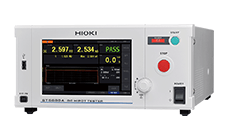
Hipot tester |
|
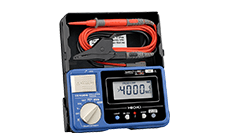
Insulation resistance (IR) |
Insulation resistance in MΩ (DC) |
Hipot tester with IR, or insulation tester |
|
Leakage current |
Current through a body-simulating network |
Leakage current tester / safety analyser |
|
Ground bond /continuity |
Protective-earth integrity |
Ground bond tester |
|
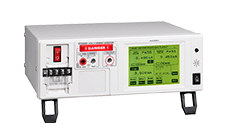
All-in-one bench /production |
Runs the full sequence in one unit |
Electrical safety analyser (5-in-1) |
|
High-volumeproduction |
Many devices /channels at once |
Multi-channelhipot tester |
|
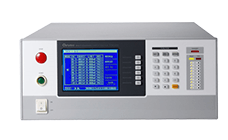
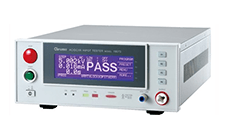
Higher-power /HV bench hipot |
Bench dielectric withstand up to 10kVAC |
Hipot analyser |
|
Wound components/transformers |
Hipot + IR forwindings |
Wound-component safety analyser |
Hipot test voltages & standards
Tested products fall into two classes. Class 1 equipment has a protective earth, live, neutral and earth. Class 2 equipment is double-insulated, with live and neutral only.
Typical hipot test voltages depend on the product's standard:
- 3 kVAC for IT and industrial equipment (IEC/EN 62368-1) and for measurement, control and laboratory equipment (IEC/EN 61010-1)
- 4 kVAC for medical electrical equipment (IEC/EN 60601-1), which also demands greater creepage and clearance
|
Standard |
Applies to |
|
IEC/EN 62368-1 |
Audio/video, IT and communication equipment (replaces IEC/EN 60950-1 andEN 60065) |
|
IEC/EN 61010-1 |
Measurement, control and laboratory equipment |
|
IEC/EN 60601-1 |
Medical electrical equipment |
|
IEC/EN 60335-1 |
Household and similar appliances |
|
IEC/EN 60204-1 |
Electrical equipment of machines |
|
IEC/EN 61558 |
Transformers and power supplies |
If you still test to IEC 60950-1, note it was withdrawn in favour of IEC/EN 62368-1. Check which standard your certification now requires. Always confirm the test voltage, method and duration against the specific standard for your product.
Acceptable leakage current and pass/fail limits
A hipot test passes or fails on leakage current. You set a maximum allowable leakage, the trip threshold and the tester fails any device that exceeds it or that arcs. The acceptable leakage current is defined by the product's safety standard, not the tester, and varies with the equipment class and application. AC tests draw more current because they include the capacitive component; DC tests measure the resistive leakage only, so the limit is usually lower.
As a guide, production hipot limits often sit in the low milliamp range (commonly around 0.5 - 10 mA), but you must take the exact figure and dwell time from the standard you certify to. Set the limit too high and a real fault passes; set it too low and good units fail on capacitive charging current.
How long is a hipot test, and is it destructive?
Test time ranges from about 10 milliseconds to 5 minutes, depending on the standard. One minute is common for type testing. Production-line tests are shorter, often one to two seconds at a slightly raised voltage to verify build consistency without stressing the unit.
A hipot test can be destructive if the voltage or duration exceeds what the design tolerates and insulation damage is hard to detect. Do not apply a voltage above the product's rating and avoid repeat testing at full voltage, use a reduced voltage for retests. One way to set a safe production voltage is to test samples to failure, then test production units at a lower voltage with an adequate safety margin.
Get expert advice on Hipot testing
Whether you're selecting a new Hipot tester, upgrading your existing test capability or looking to improve electrical safety and compliance, APC can help.
Talk to our technical team today to discuss your requirements, arrange a product demonstration or get support choosing the right Hipot solution for your application.
APC's engineers can provide technical advice, ongoing support, and hands-on product demos to help you make the right decision with confidence.